What Does the "K" Mean in Carbon Fiber Tow?
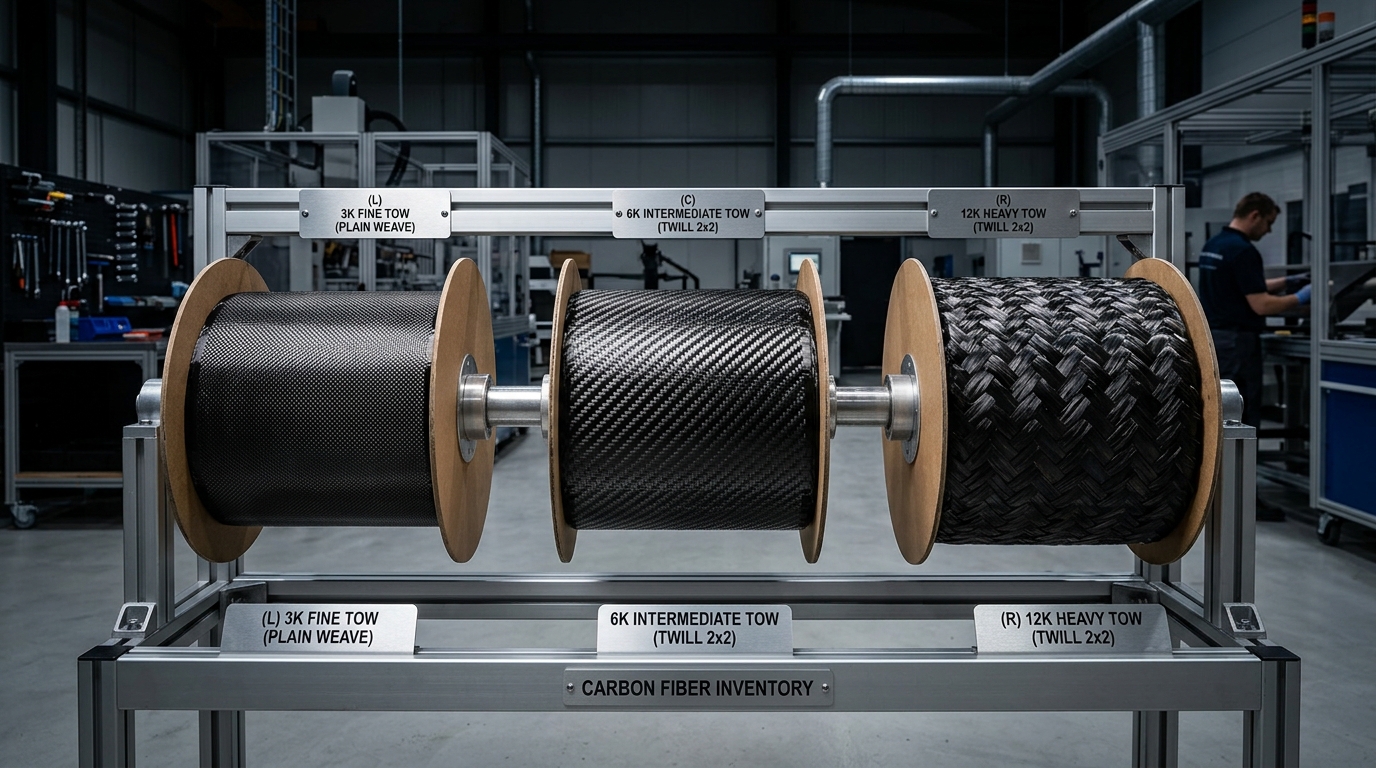
In composite manufacturing, the letter "K" denotes kilo, indicating thousands of individual carbon filaments bundled into a single untwisted tow or yarn. A 3K tow contains 3,000 filaments, a 6K tow contains 6,000 filaments, and a 12K tow contains 12,000 continuous filaments.
Each individual filament has an ultra-fine diameter of approximately 5 to 7 micrometers (roughly one-tenth the diameter of a human hair). While single filaments are fragile, bundling them into calibrated tow yields extreme tensile load-bearing capability along the fiber axis.
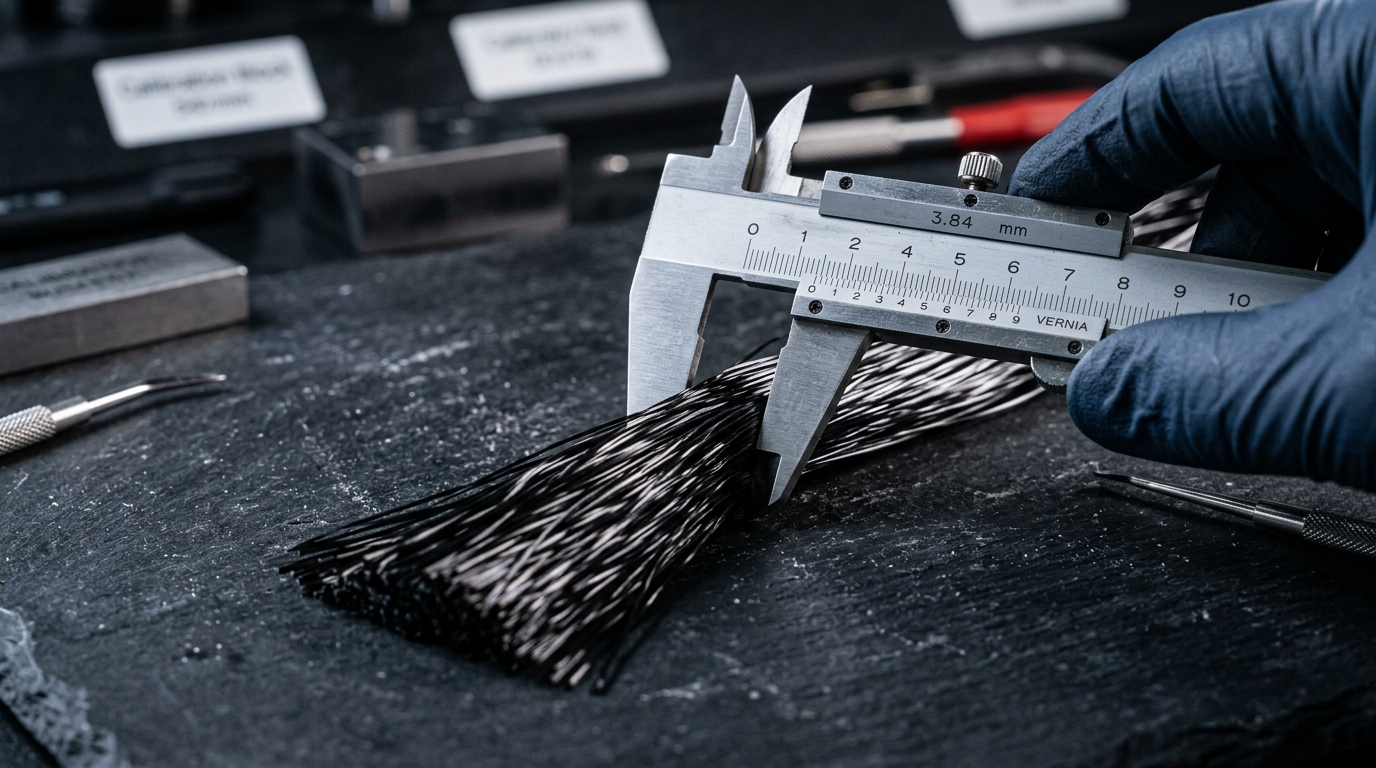
It is important to understand that filament count does not dictate carbon fiber tensile strength. A high-tensile continuous filament (such as standard modulus T300 or intermediate modulus T700 grade) possesses the same inherent tensile strength (~3,500 to 4,900 MPa) whether bundled into a 3K or 12K tow. What changes fundamentally is the yarn cross-section, linear density (yield), and fabric drapeability.
Physical & Mechanical Properties Comparison
The table below summarizes the key technical parameters across 3K, 6K, and 12K carbon fiber reinforcement fabrics supplied by Shaanxi Fortex Technology:
| Parameter | 3K Carbon Fiber | 6K Carbon Fiber | 12K Carbon Fiber |
|---|---|---|---|
| Filament Count | 3,000 filaments / tow | 6,000 filaments / tow | 12,000 filaments / tow |
| Linear Density (Yield) | ~198–200 g/1000m (Tex) | ~395–400 g/1000m (Tex) | ~800 g/1000m (Tex) |
| Standard Fabric Areal Weight | 160, 200, 240 g/m² | 280, 300, 320 g/m² | 400, 450, 600 g/m² |
| Typical Cured Ply Thickness | 0.20 – 0.25 mm (0.008–0.010 in) | 0.30 – 0.35 mm (0.012–0.014 in) | 0.45 – 0.60 mm (0.018–0.024 in) |
| Tensile Strength (Dry Tow) | 3,530 – 4,900 MPa | 3,530 – 4,900 MPa | 3,530 – 4,900 MPa |
| Tensile Modulus | 230 – 240 GPa | 230 – 240 GPa | 230 – 240 GPa |
| Drape & Conformability | Exceptional (tight 3D radii) | Moderate | Stiffer (best for gentle curves/flats) |
| Relative Cost per Kg | Higher (more spinning passes) | Moderate | Lowest (mass production efficiency) |
Drapeability, Mold Conformability & Resin Infusion
When laying up composite components, the choice of tow size directly dictates how well the fabric accommodates three-dimensional mold geometry:
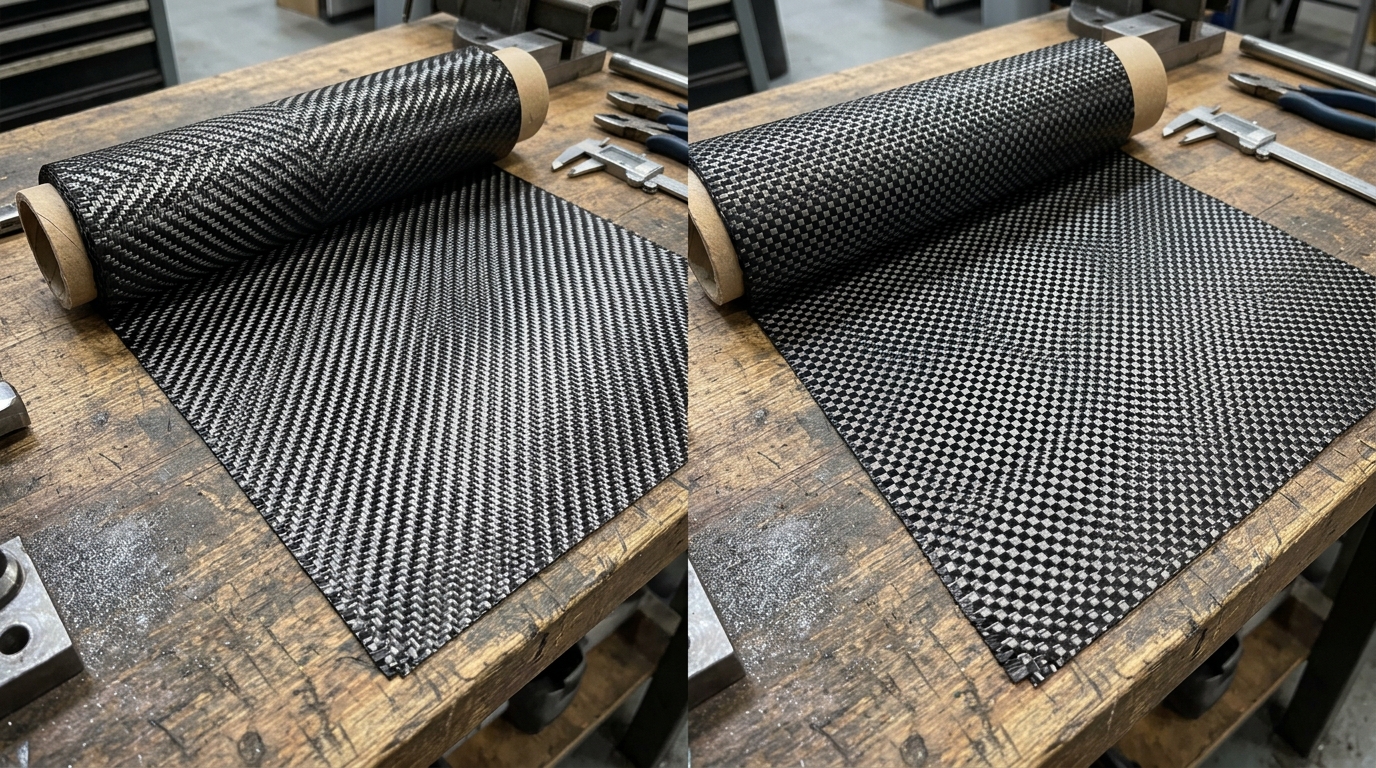
- 3K Fabric Drape: Because 3K tows are thinner and lighter, 3K woven fabrics (especially 2x2 twill) can shear and deform smoothly over tight compound curves, sharp fillets, and intricate automotive molds without bridging or fiber wrinkling.
- 12K Fabric Behavior: 12K tows are significantly wider and thicker. While 12K fabrics produce stiffer, thicker single plies, they resist tight multi-axial draping. Attempting to force heavy 12K fabric into small negative radii often results in resin pockets or internal voids.
- Resin Permeability: In vacuum infusion (VIP) and resin transfer molding (RTM), 12K fabrics feature larger macro-channels between tows, facilitating rapid resin front advancement. However, complete micro-wetting within the dense interior of a 12K bundle requires careful resin viscosity management.
How to Choose: Practical Engineering Guide
Use the following guidelines when specifying carbon fiber reinforcement for production:
- Choose 3K Carbon Fiber if: You are producing visual cosmetic parts (supercar body panels, motorbike fairings, sports equipment, helmets) where a classic weave appearance and seamless surface finish are paramount, or where parts have tight, intricate contours.
- Choose 6K Carbon Fiber if: You need an optimal balance between rapid wall thickness accumulation and reasonable drapeability for medium-sized industrial components.
- Choose 12K Carbon Fiber if: You are manufacturing thick structural laminates, industrial tooling backings, wind turbine blades, marine hull cores, or pressure vessel overwraps. 12K builds structural thickness with half the ply count, slashing labor costs by up to 50%.
Composite Materials
Need Certified Composite Materials or Custom Parts?
Shaanxi Fortex Technology supplies 3K/6K/12K carbon fiber fabrics, woven glass reinforcements, and matched epoxy systems with certified batch COA and roll traceability.